
Note №3
Mimesis of Psyche
25 November, 2024
This new concept is grounded in the desire to achieve a deeper form of realism, one that corresponds to the present time. Mimesis itself lies in the pursuit of this form, in our attempts to reflect life and create an image of reality through imitation of reality itself.
In this sense, it allows us to trace connections between ancient art, medieval iconography, the Renaissance, and realism, which together form key blocks of contemporary art. These approaches all imitate reality, yet from different perspectives and with varying degrees of depth.
Accurately depicting a tree was once already considered an achievement, just as later capturing volumetric space became a milestone. A similar progression can be seen in religious art, where the difference between early Christian frescoes and medieval iconostases is clearly tangible.
So we can see that our capacity for mimesis evolved both through the depiction of material reality and the depiction of the spiritual. Occasionally they intersected, but these intersections remained unsystematic and still hold potential for further exploration.
One reason progress has been difficult is that our fragility makes us focus on social aspects, reducing profound phenomena to societal rules. As a result, the idea of realism is often distorted: the depiction of ordinary lives becomes central, while deeper images of reality are overlooked.
Yet what was Dostoevsky engaged in if not realism? By realism he meant a truthful and profound depiction of human beings, including their thoughts, experiences, and inner states. The very possibility of achieving such detailed representation was his aim, and this is precisely the task of mimesis.
Here we can observe an attempt to erase the boundary between material and spiritual reality. This merging occurs within the human psyche, which encompasses both dimensions of life. The beginnings of such experiments coincided with the development of psychology as an introspective form of science.
Alongside this, ways of depicting reality began to change. Consider Levitan and Savrasov. Both may appear similar, yet the difference is significant. Savrasov finds correspondence to his inner states within nature itself, while Levitan conveys his emotions through imagined landscapes.
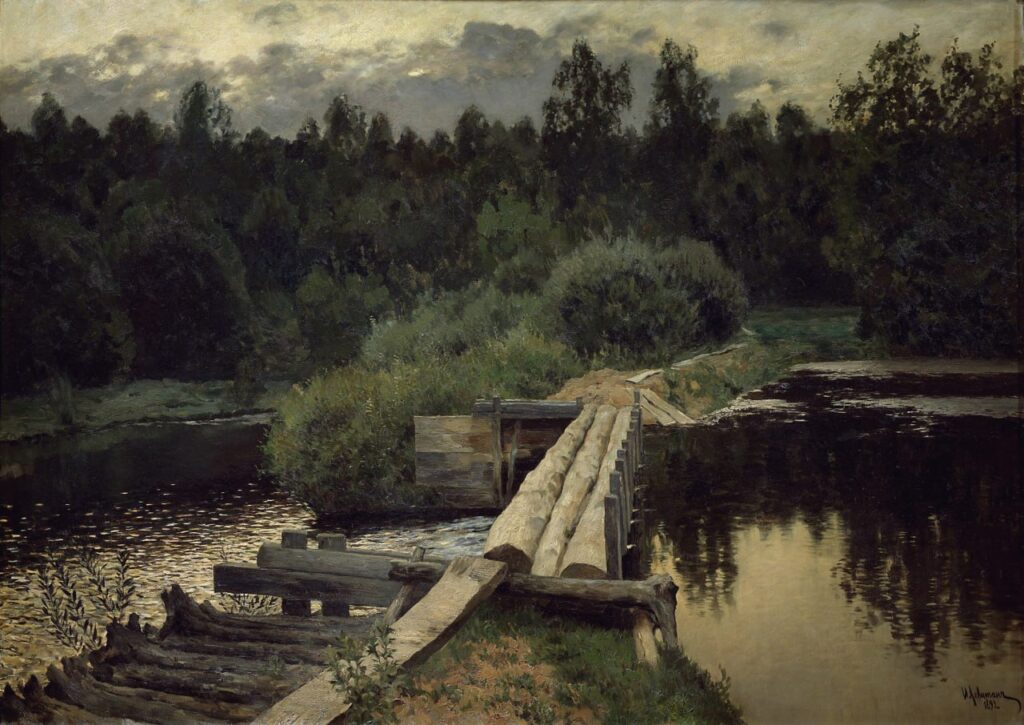
It is the difference between feeling that a spring landscape evokes hope and creating a landscape where melancholy, nostalgia, inspiration, and excitement are all present. The latter approach departs from linear dramaturgy toward a more complex narrative with nonlinear, volumetric, and sensorial composition.
This movement is also evident in Antonioni, Fellini, and Tarkovsky. These artists valued realism despite their aesthetic experiments, using every possibility to portray humans authentically.
Each attempted to abandon linearity and transform two-dimensional storytelling into the polyphonic breath of the living human soul. Tarkovsky’s Mirror feels so real and indefinable because the inner world is shown in its complexity.
But if artists have already depicted the human psyche, what is new and necessary in the approach I describe?
The answer lies in its unsystematic nature. Like psychology, 19th- and 20th-century art explored this domain tentatively. Themes that have weak expression in everyday life are difficult to work with, whether through environment, objects, or technology. The idea anticipates its time.
Gradually, its relevance emerges. During the early industrial era, the shift from agrarian to industrial life was abstract. Today, reality with massive concrete cities, mechanical technologies, and mass-produced objects seems familiar, yet it consists almost entirely of ideas and concepts.
Originally, objects had measurable functions and value. Now, functionality exists for every purpose, and the environment has become a complex set of abstractions such as the internet, content, memes, and cryptocurrencies.
We are moving from functionality toward the non-functional. Interest is growing in experiencing states, exchanging psychic experiences, moods, and introspective values. The same process occurs, though more slowly, with spaces and objects, which now form a superstructure over industry.
Possibly, in the near-future world, both virtual and real spaces may exist as mystical islands within familiar environments. Objects whose function is not obvious may still hold undeniable value because they address psychic needs.
Visualization of the psyche, generation and recording of dreams, analysis of mental distortions, and the ability to predict aspects of oneself are all integral to this emerging world.
This highlights the insufficiency of previous art, which often lacks a systemic perspective on processes within the human mind. To reach the next level of realism, we must view the psyche in perspective and create its artistic map. The approaches of Levitan and Tarkovsky should be extended using contemporary psychology.
Mimesis of psyche represents a new level of realism. It can be described as the desire to depict nonlinear experiences and the continuously expanding dynamic personality. This multidimensional art departs further from conventional dramaturgy and composition while portraying humans in a form closer to reality.
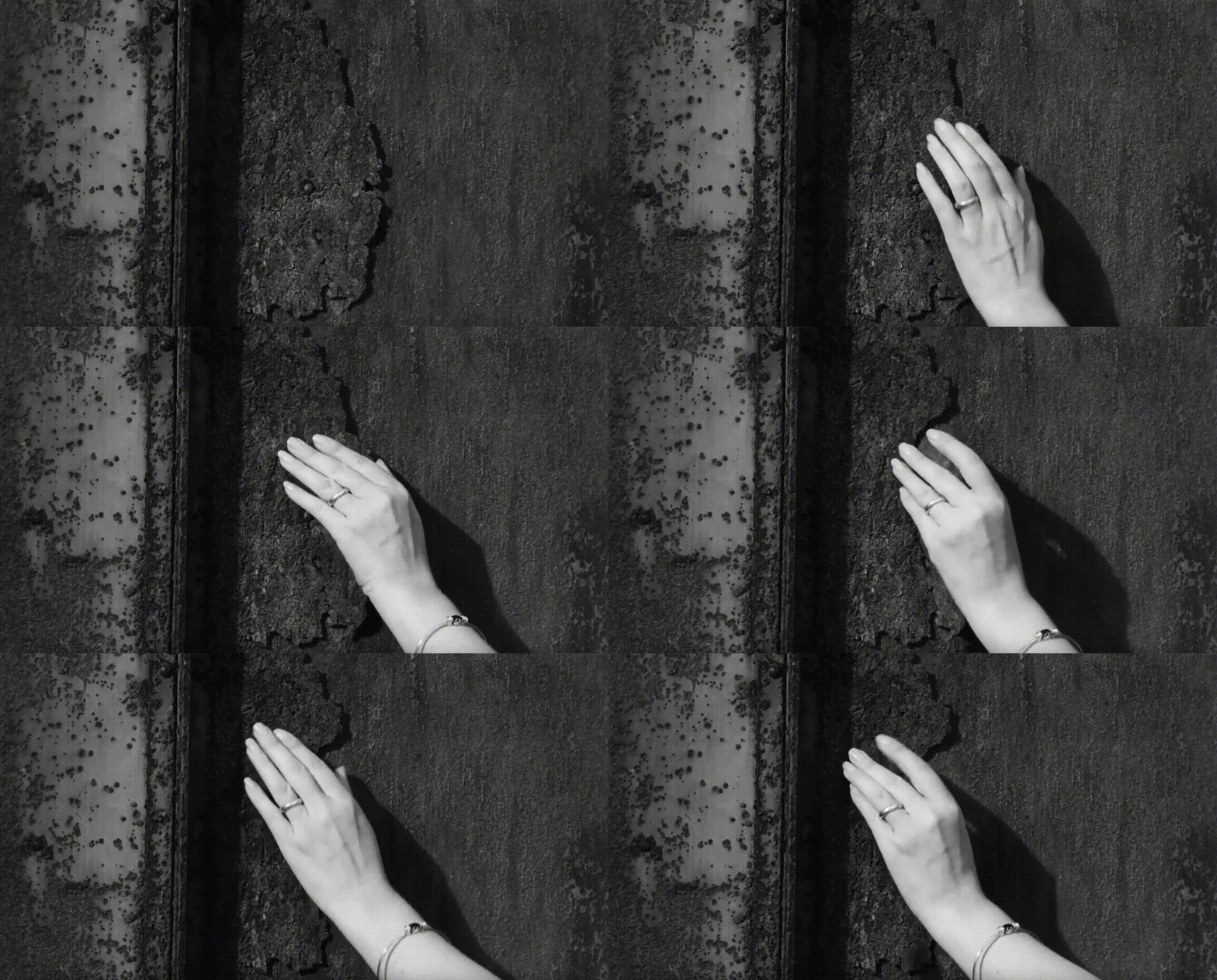
Therefore, that approach is the imitation of the human psychic dimension to achieve realistic artistic visualization, making art proportional to the present.
One can imagine an exhibition without formal boundaries, evolving in both digital and analog environments. Its theme is the human psyche, the exploration and depiction of our states, and the distortions that prevent us from seeing answers.
Music flows beyond conventional composition, films embody states, and painting visualizes the inner world in layered images. Such art opens perception of ourselves, allowing us to sense the edges of the psyche and inspiring life.
This transition can occur suddenly, like switching between L’Avventura and Blow-Up. Though only six years apart, an unfathomable gap separates these two films. That final touch closed the era of the Casablanca generation and made A Space Odyssey mainstream.
Something similar unfolds today as people learn to perceive subtle phenomena. This is a time when the market capitalization of meme coins exceeds that of some major companies. Abstraction, inaccuracy, and dynamism have become commonplace for most.
All of this is also a harbinger of the development of interfaces for the psyche, which will make our inner world more visible.
