
Note №2
Interface for the Psyche
24 July, 2024
Looking back over history, it becomes clear that as technology advances, society grows more complex. Populations increase, life expectancy and quality of life improve, and the web of social connections, professions, and opportunities expands.
As complexity increases, so do the challenges we face. They demand ever more sophisticated technologies, born from the integration of past discoveries and continuous collective creativity. All of this requires ongoing management and support.
Therefore, the question of how we can solve problems together more effectively remains unresolved and ever relevant.
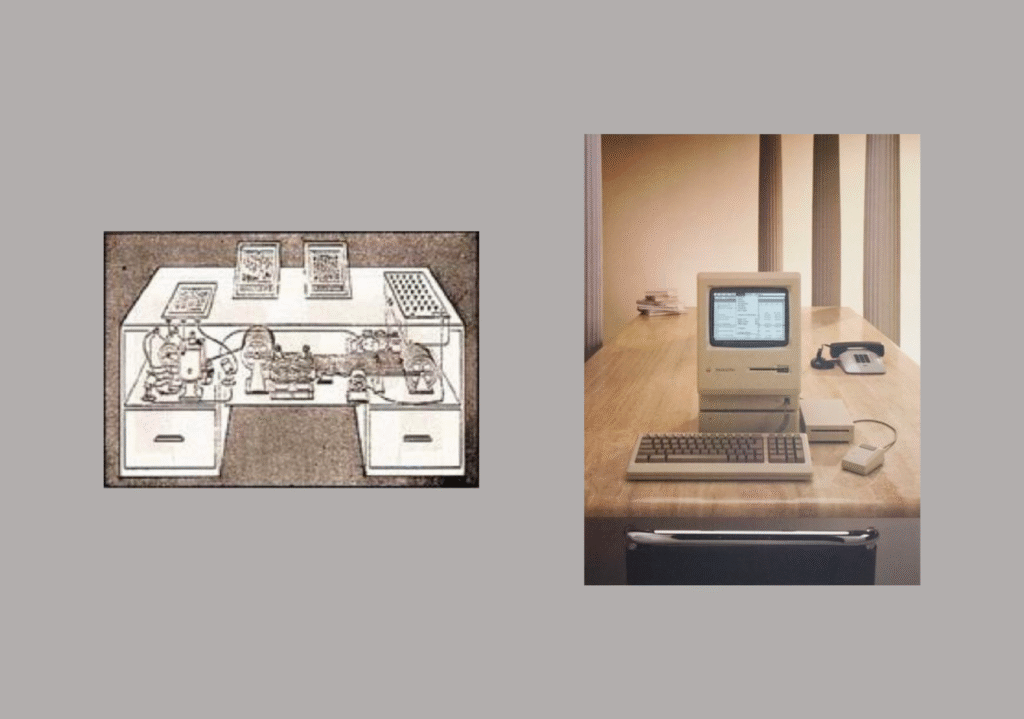
Previous attempts to answer it brought us personal computers and the internet. These innovations reshaped the way we think and live. They were first motivated by the need to perform complex calculations quickly and later by the desire for better tools to communicate and manage knowledge.
Today, many of these challenges have solutions capable of meeting current societal demands. But now, a lack of vision is once again apparent in this field. Researchers often focus on replacing human thought with machines or enhancing biology through technology.
Probably, our fascination with imagining both wondrous and grim futures is part of human nature. Even in scenario planning, such possibilities are weighed alongside pragmatic forecasts.
Predicting the future based on the notion of human inferiority, however, is different. It places simpler, artificial systems above ourselves and risks undermining the human perspective.
This situation suggests that we need to reconsider our collective effectiveness and imagine a new vision of the future. At the heart of this vision should be the study of humans and our deeper needs in a post-industrial world.
After all, the development of a sophisticated technosphere has increased comfort, but it has also given people more time to reflect on their place in a changing global environment and to explore self-realization. This shows that untapped potential still resides within us.
Yet even today, few of us find what can truly be called a purpose. Most of us experiment, learn through trial and error, or seek guidance from mentors, yet clarity is rare. The task is so complex and deeply personal that it is often beyond our capacities.
This leads to a rise in frustration and lack of motivation, limiting engagement in personal growth, practical endeavors, or cultural pursuits. But if we had ways to explore ourselves and develop our abilities, personal fulfillment would rise, and society would benefit.
This points to the need for technology designed to help people understand themselves. Such tools could visualize the psyche and track its changes dynamically, functioning like a graphical interface to the inner mind.
Foundations for this already exist in applied psychology and in emerging integrative theories of personality, which aim to map the psyche as a system. Further progress in this area could make this vision achievable in the near future.

Imagining how these tools might work allows us to foresee changes in everyday life over the coming decades.
Alongside the rise of a new market for psychological technologies, our understanding of the economy could expand. Resources and capital might be joined by human potential and ways to measure it, and supporting each individual’s unique abilities could become a societal value.
This shift could increase investment in human development, making personal fulfillment a key priority. Greater attention will be given to creating supportive environments for family, work, learning, and restoration.
Changes will also occur in the way we think. Visualizing the psyche could help us understand ourselves and others more clearly, allowing society to become more integrated and attentive to what lies beyond our differences.
At the same time, we must remain aware that these technologies carry unknown risks and could lose their social purpose if guided solely by financial interests.
