
Essay №2
Blockchain canvas as a new art medium
December 2023
Last year, I released the Eternal Harmony art series, in which I addressed two key challenges. I created ever-changing paintings based on the Ethereum blockchain and developed a distinct aesthetic for them.
These works consist of numerous elements painted with real watercolors and oil pastels. I devised a method for transferring them into a digital algorithm that can automatically generate new paintings from these elements.
The results are identical to my traditional works, and token holders can observe them appearing every three days. The algorithm simply erases old images and creates new ones, and this process can continue indefinitely.
This combination of solutions revealed a new aspect of fine art and enabled a unique experience that was previously unattainable. Here, “painting” becomes a continuous process of creating new paintings, which you can observe.
Creating such a work required rethinking the medium itself, called the concept of a dynamic canvas. Its main characteristic is the time during which the work can continue to reveal itself to us. It must function autonomously and reliably, possible only through the blockchain.
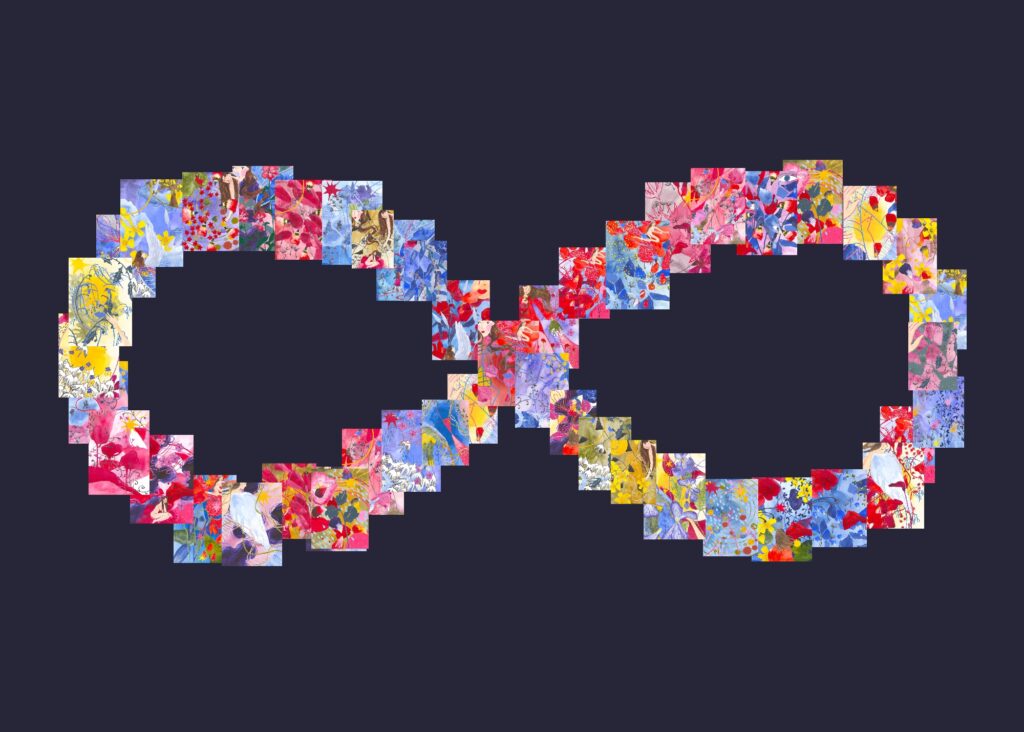
Ever-changing painting, 2022
My project is not the only one in this field. Artists such as Figure31, Matt Kane, deafbeef, Mathcastles, and James Bloom have also created living art but used new technical possibilities in their own creative ways.
For instance, Matt Kane created Gazers—dynamic paintings on the blockchain that follow the Moon’s movement and reflect its phases. These works were created in his unique style, reminiscent of generative op art, and also engage with the concept of time.
Other artists approached different ideas and styles. Some used glitch and abstraction to reflect market phenomena, others explored evolution through biomorphic forms, and some, like me, reinterpreted analog art through a dynamic form.
I see this as evidence that blockchain genuinely expands the possibilities of art. It is clearly more than just file storage or authentication technology, which the ascribe team envisioned in 2013:
“Digital files have different properties than physical paintings: they can be copied easily with no loss of quality and spread on the internet in seconds. We had been asking the question, how do you collect digitally based artworks? Then we realized, what if you could own digital art the way you own Bitcoin?”.
A decade later, we see that the blockchain has not only enabled digital art collecting, but also become a new tool for artists to work with form. It allows for the creation of living paintings through experiments with various ideas and techniques.
We are witnessing the emergence of a new kind of digital art that relies on the blockchain and cannot exist without it. This field remains small due to its technical complexity, but each project is unique and filled with the energy of discovery.
This could be called autonomous dynamic art or blockchain art, though I prefer to leave it beyond labels and genre boundaries.
━━━

This is a white canvas, but not made of paper or fabric as in traditional art. It consists of bits, encoded in the blockchain, with virtually unlimited dynamic capabilities.
Despite its uniqueness, this blockchain canvas still has the basic features of a regular canvas. It still evokes the thrill of the unknown and a strong desire to create something.
This is the feeling every artist experiences before beginning a new work. Sometimes we do not even know what the next painting will be and simply follow intuition to see what emerges.
I believe this is the most intimate part of the creative process, and many of us create art just to experience it again. Unfortunately, this aspect is often hidden from the viewer.
But what if you were present as I create a new painting? This could significantly alter your perception, making the process itself feel like an integral part of the work.
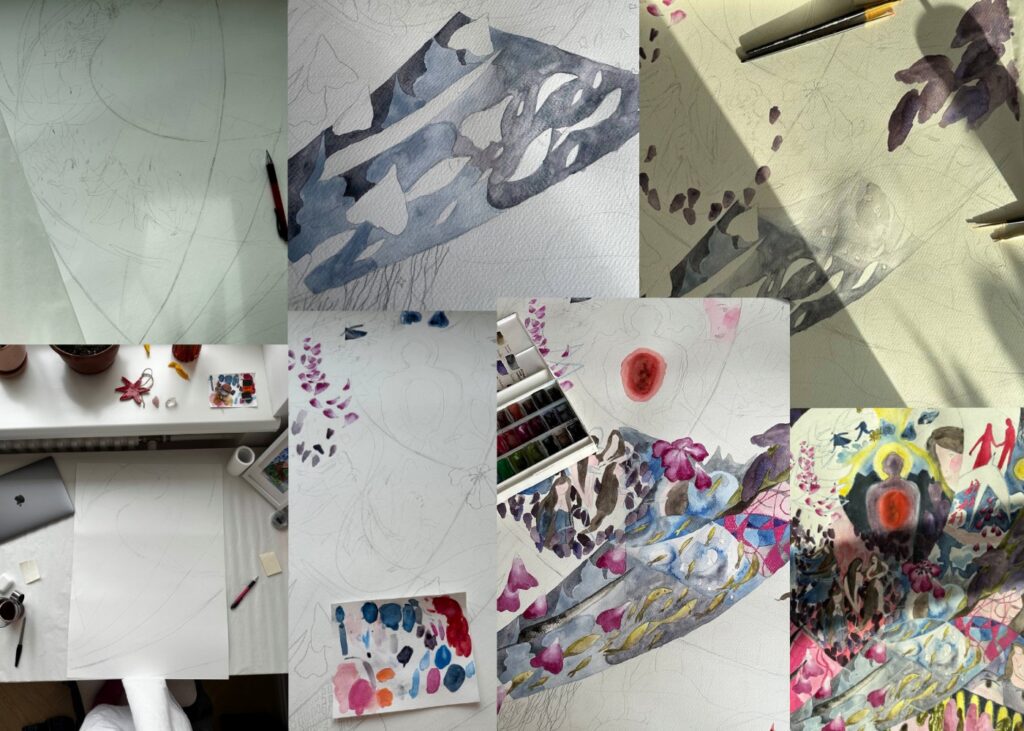
The process of drawing my 1/1
Together, we can experience how something emerges from nothing. The composition becomes tangible, outlines appear, and brushstrokes gradually reveal emotional content.
Then the work is not just a new painting, but a new perspective on it. It becomes even more like a film, where images gain value through their dynamics and evolution over time, while still remaining a drawing.
Implementing this idea became the primary goal of my new project. I realized I would have to work at the edge of current technical capabilities. Not only with smart contracts but also with drawing, generative algorithms, and aesthetics in general.
I felt that this was necessary, because I consider it important to understand the potential of blockchain for art both from a theoretical and a technological perspective. Only bold and complex experiments can reveal its possibilities and take us further.
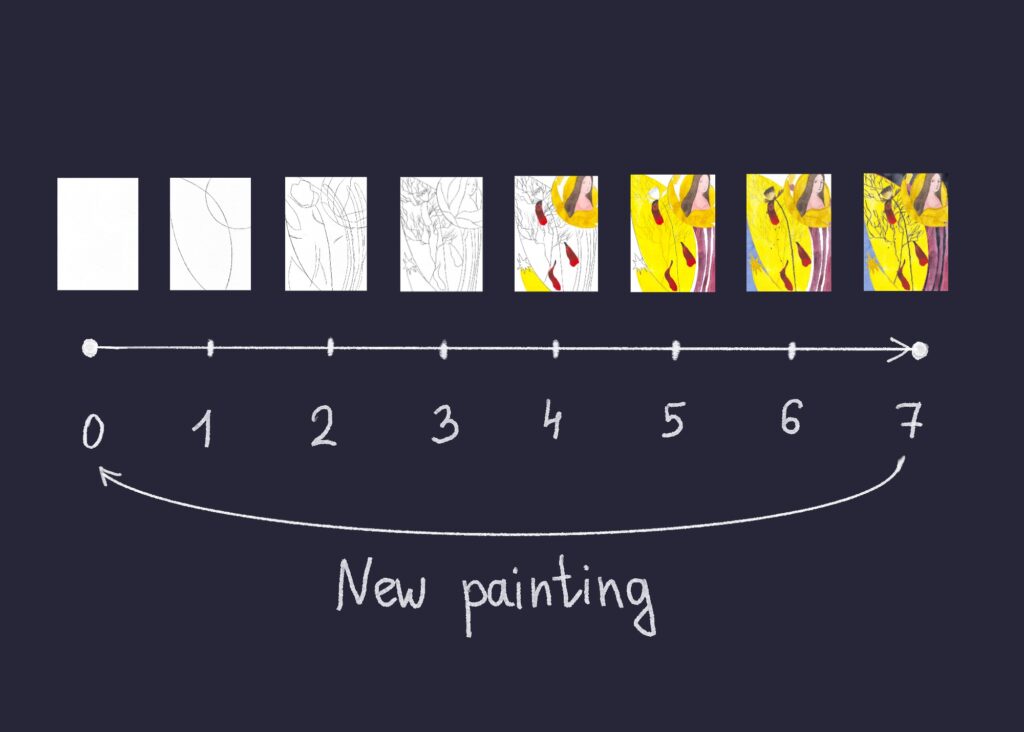
PI, Drawing process
Using a unique canvas allowed me to transform the painting into an immersive story. You can now see every stage of its development, from the first sketches to the final result.
It looks very natural, as if I was painting the picture in front of you. But I have nothing to do with this directly. This is done by an algorithm that completely replicates my artistic style and my way of thinking.
And, yes, this happens on its own within the blockchain.
Essentially, you witness a perfect imitation of my creative process and can explore it to understand how my paintings function internally. This allows for a deeper perception of the work.
The painting now encompasses the white canvas, the creation process, and the result all at once. You can own this canvas and decide when to initiate the creation of a new painting.
For the algorithm, this process takes seven days. Each day represents a new stage with fresh strokes, colors, and details, gradually revealing and giving meaning to the image.
On the seventh day, the process ends, and the finished work can be admired indefinitely. You can erase the work and rerun the algorithm to create a new one, and this can be repeated infinitely.
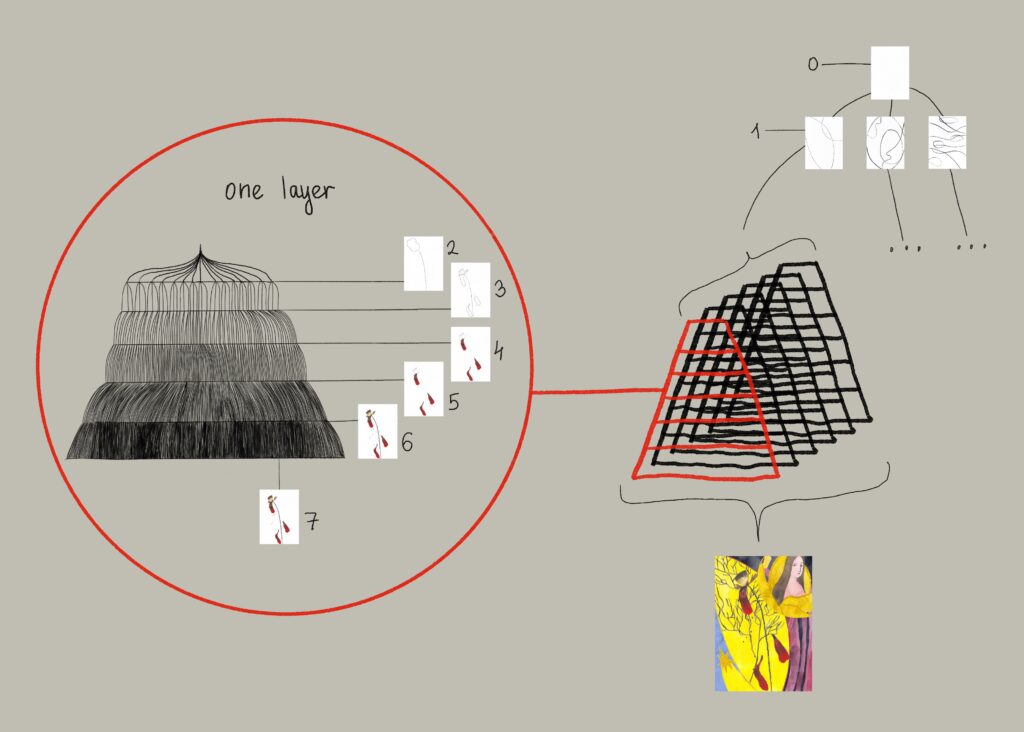
PI, Algorithm
This is the structure of an algorithm that interacts with all painting elements and stores the logic for doing so. This is a sophisticated system with seven sublevels, each with several random ones chosen from a large number of forks.
As a result, each painting appears to be a multi-layered cloud of disparate but interconnected images. As if it were a sand castle, something light and metaphorical emerges from ornate program patterns.
The most challenging aspect of this stage was understanding the principles of dynamic composition, which allow paintings to develop in stages. It was crucial to achieve seamless layering of randomly generated images.
This may not be an obvious point, but those with good spatial reasoning can relate. It is similar to holding an entire action plan in your mind while working on each step simultaneously.
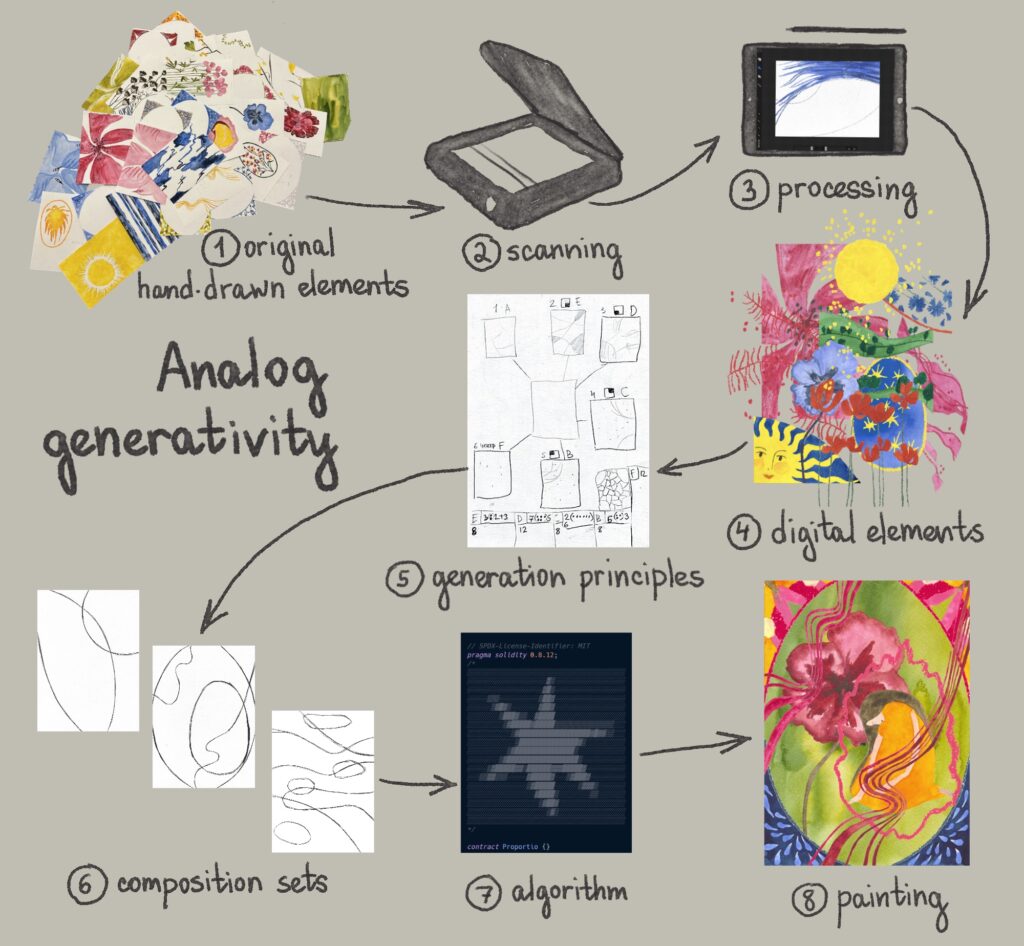
PI, Original elements
Another key aspect is that the elements themselves are painted with real materials. I continued developing my approach to analog generativity and explored a wider stylistic range this time.
I am convinced that the concept of a self-creating painting could only be fully realized in this way. It adds a special depth to the images and significantly increases the sense of reality.
Consider how painting on paper works. There is no room for error, and you cannot undo previous strokes. The process flows continuously, which perfectly complements the project’s concept.
Finally, there is the smart contract. It is again a fully decentralized solution that ensures the longevity and autonomous operation of all algorithms.
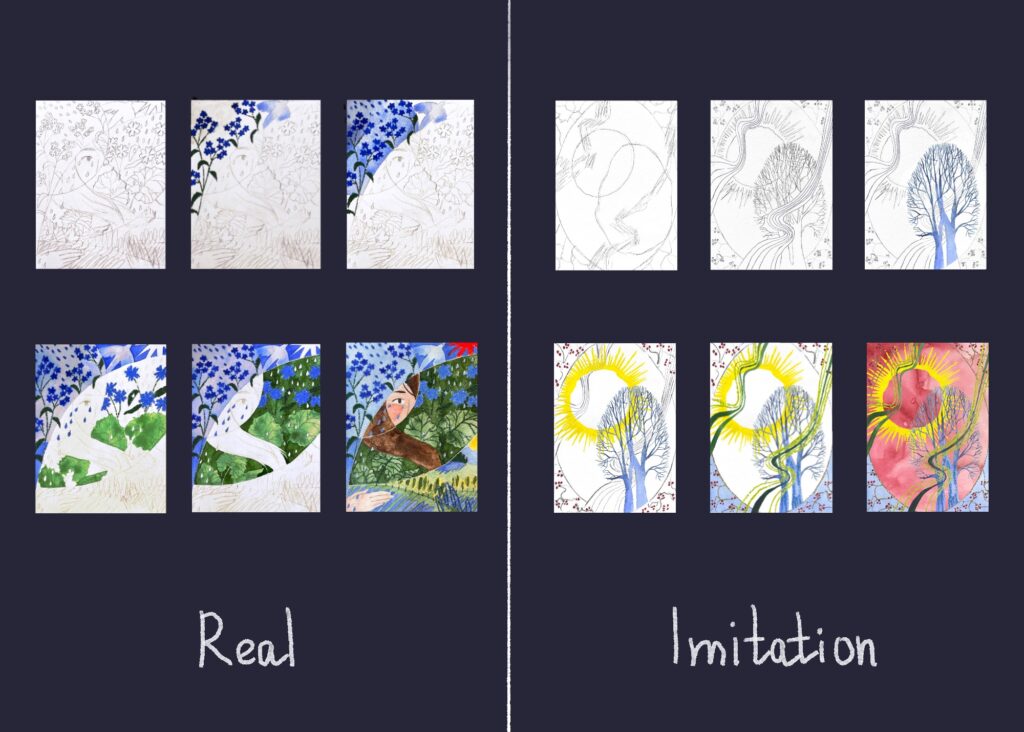
PI, Comparable result
In this project, I primarily focused on expanding my own theory and practice within a still largely unstructured and under-theorized area of art.
(1) Theory
I delved deeper into and articulated the finer conceptual aspects of autonomy and dynamism in the digital contexts. It also made sense to develop the idea of blockchain as a creative medium more fully, showing not only myself but also other artists its potential.
(2) Practice
A new understanding helped me refine a stylistic and technological framework. I moved beyond the undeniably charming, yet somewhat detached, mutability of my previous work and created an autonomous system with which the viewer can interact.
Working at this level now gives me insight into moving toward a more responsive, subtle, and psychorealistic form of art, where interaction between viewer and artwork will become a process of mutual reflection and perception through imagery.
