
Essay №3
Framework for blockchain art
June 2024
My earlier experiments evolved from exploring the autonomy of the image in Harmony to the autonomy of the painting process in PI. The latter was also a radical expansion of the former.
Now, all of this needs to be brought together.
The task is not so much to create individual artworks as to establish the conditions in which they can exist. A system for my digital art practice, with its own autonomy.
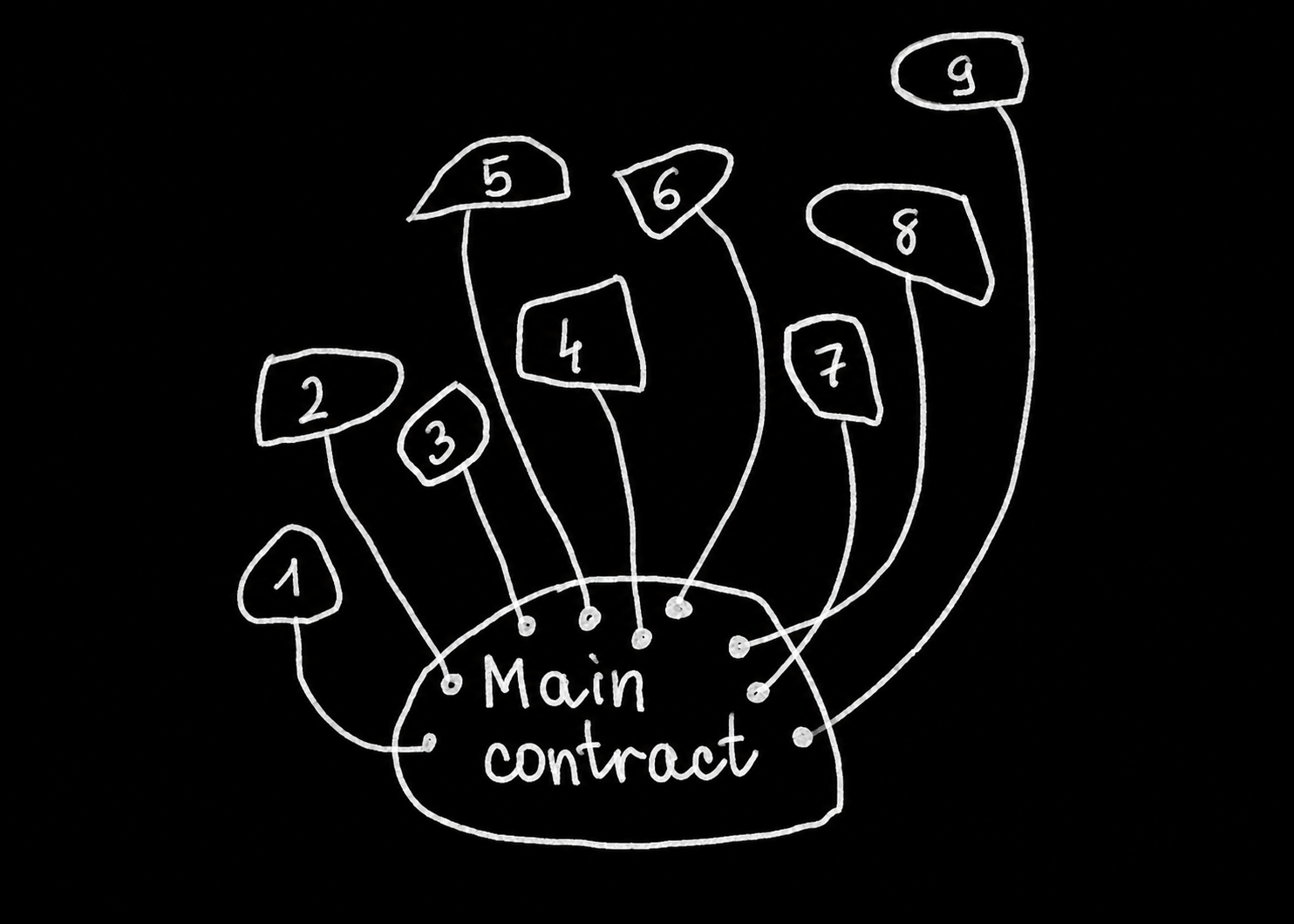
Smart contract network
The first step was to connect Ethereum smart contracts into an expandable network. Each artwork has its own contract linked to the main one, allowing me to add new works to a single collection.
This is important for artists like myself, whose roots lie in traditional painting. Unlike generative series, each one-of-one may require a different artistic approach and technical structure. And as long as new code can be added, the system remains alive.
I also saw this as a conceptual exploration of how an artist’s practice can exist on the internet. The wallet serves as the primary identity, while contracts allow artworks to be connected.
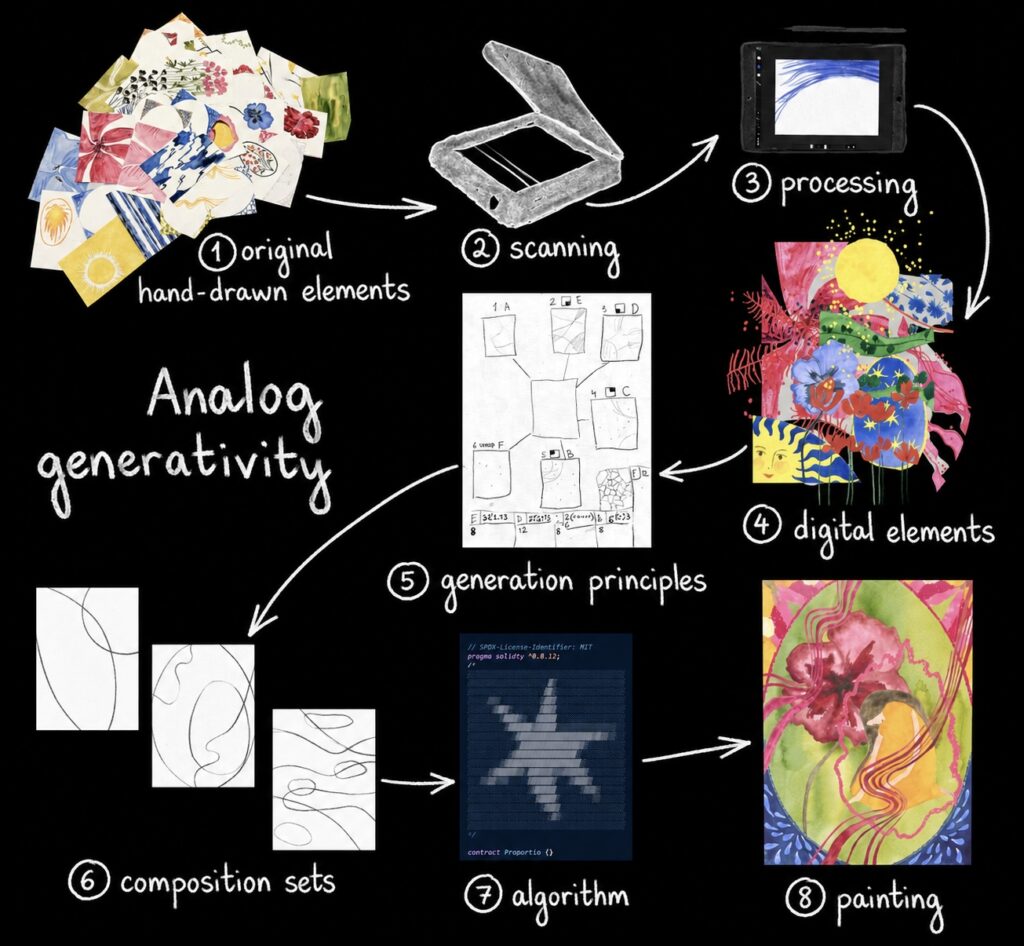
Analog generativity
The second step was to systematize the analog generativity developed in my earlier projects. I was less concerned with style than with defining the possibilities and limits of this approach.
As the diagram suggests, almost every step allows for a wide range of possibilities. The visuals, processing methods, composition, and underlying algorithms can all vary.
In many ways, this resembles traditional painting, where you can change the surface or materials and express any idea within a given format. But the possibilities extend even further.
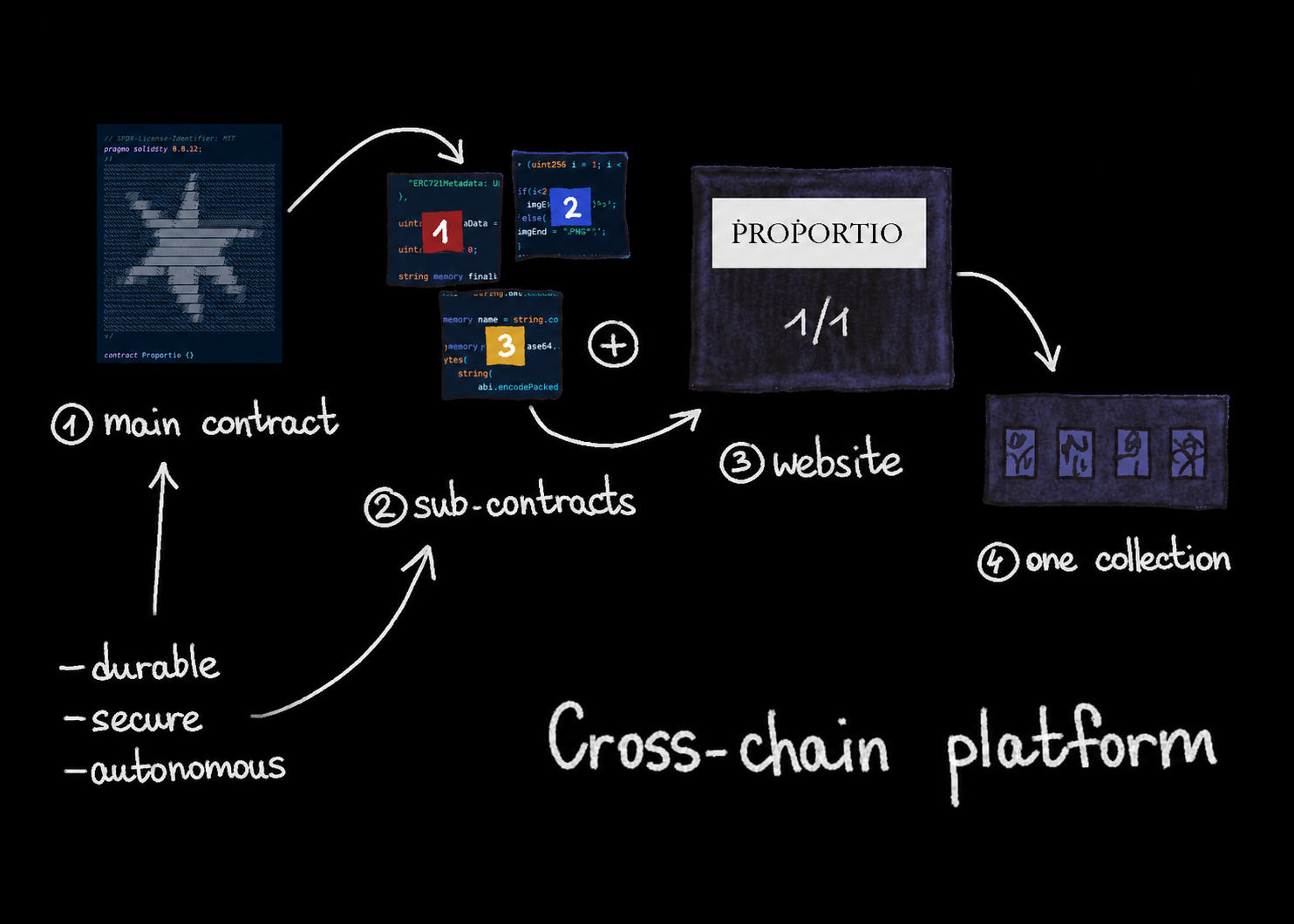
Web integration
The final step was to consider how the works would appear in galleries and auctions, something the community had already solved. This gave the entire structure a complete and elegant form.
In essence, a wide range of websites and interfaces can interact with these contracts. This can serve not only functional purposes but also expand the aesthetic experience.
Together, these elements form an open framework and a set of rules for creating art in the digital space. This allows my practice to mature and opens the way for further exploration.

Monochrome, Seven-day intervals
Monochrome became the first work I created within this new system. It offers another perspective on autonomous paintings, concentrating the entire experiment within a single artwork.
This is also a kind of expansion, but in the opposite direction. While PI explored greater visual and technical complexity, this work shows what radical simplicity can look like.
Conceptually, it is closer to Harmony, though it has its own distinct attributes and composition. Its character is more subdued, yet remains dreamy and introspective.

Monochrome, Generative process
Its ever-changing nature also follows a different rhythm. I wanted the experience to feel more measured, allowing the painting to transform slowly into a new state every seven days.
This work embodies my early vision of an ideal digital painting, imagined when I first explored the medium. Its algorithm could generate an entire collection, yet it does not.
There is something selfless about that choice. The market and fear of expectations often discourage us from pursuing such ideas, but how else can art remain spontaneous and free?
The work offers part of the answer, and the framework adds to it.
