
Essay №1
Combining analog and digital art
December 2022
The intersection of analog and digital art has been the central theme of my work since I began experimenting with non-fungible tokens in early 2021.
Before that, I had always worked with organic materials: real pencils, watercolors, and oil pastels. I did not abandon this practice even when moving into digital space, because physical contact with form is fundamental to my creative process.
I believe that the key difference between traditional drawing and purely digital work lies in the invisible connection that exists between the artist’s psyche, the body, and the artwork itself. This is related to what I call the reversibility between psychic potency and the expressed image.
In other words, form and imagery are directly connected to the inner state of the artist. Lines are not merely marks on paper; they are reflections of specific mental objects, translated into visual form.
The whole form and images have a direct connection with the state of the author’s psyche. And in my opinion, lines are not just dashes on paper; they are a reflection of specific mental objects in the form of images on paper.
This is why physical contact with the work is so important to me. Only through it can I fully express myself on the canvas and consciously regulate the emergence of certain images, sensing in advance how they might affect the viewer.
Analog media play a crucial role here due to the high complexity of color and texture they allow. Their richness and depth remain, for me, incomparable to those of purely digital graphics.
At first, I simply scanned my analog paintings in high resolution and tokenized them. Visually, this approach worked reasonably well, especially since some of my works are stylistically close to generative art.
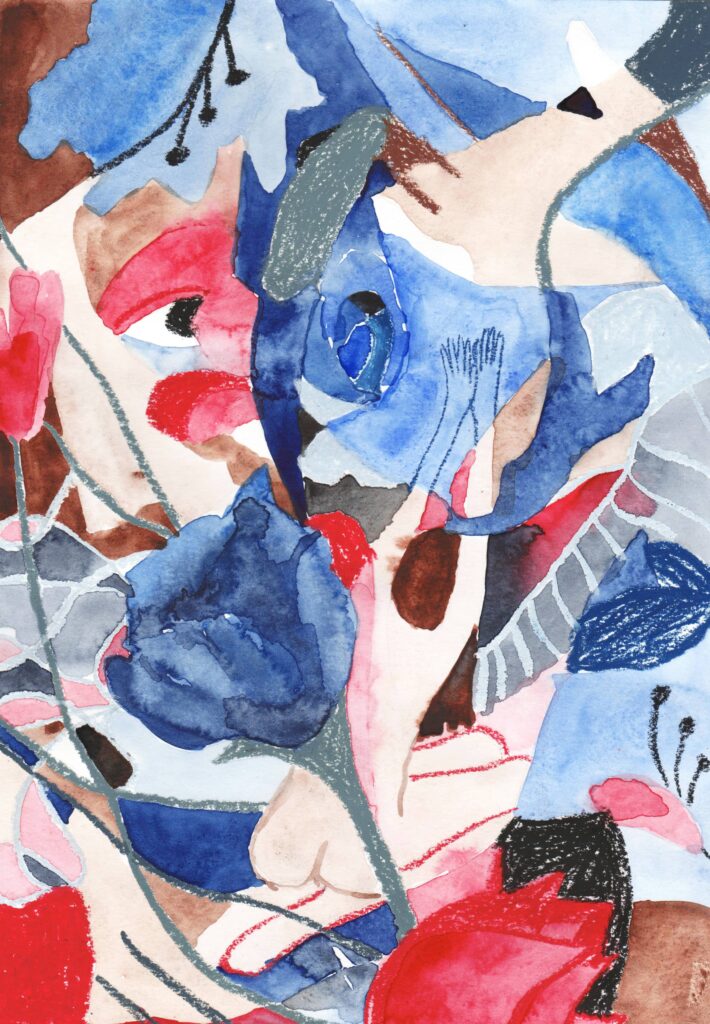
One of my early works, 2020
However, I soon realized that this format had significant limitations. On the one hand, scanning diminished the value of the original analog works, which have a much stronger impact in physical space. On the other hand, art that uses the blockchain as its foundation requires its own organic form.
This led me to search for a way to preserve what is essential to the traditional approach while integrating it with digital media and the capabilities of the blockchain. This convergence could lead to the emergence of a new visual formula.
Jason Bailey (Artnome), in his essay “Why Love Generative Art?”, articulated a thought that became a turning point for me:
“Unlike analog art, where complexity and scale require exponentially more effort and time, computers excel at repeating processes near endlessly without exhaustion. As we will see, the ease with which computers can generate complex images contributes greatly to the aesthetic of generative art”.
But is it possible to try to combine the best of both approaches?
Reflecting on this question, I realized that the digital canvas itself is a dynamic and potentially infinite space. Its depth and perspective, when combined with generative algorithms, allow images to remain autonomous and continuously evolving.
I then began to think simultaneously as an analog and a digital artist. It quickly became clear that achieving something like analog generativity would require a distinct compositional system. I needed a way to draw elements by hand and then assemble them harmoniously in a digital environment.
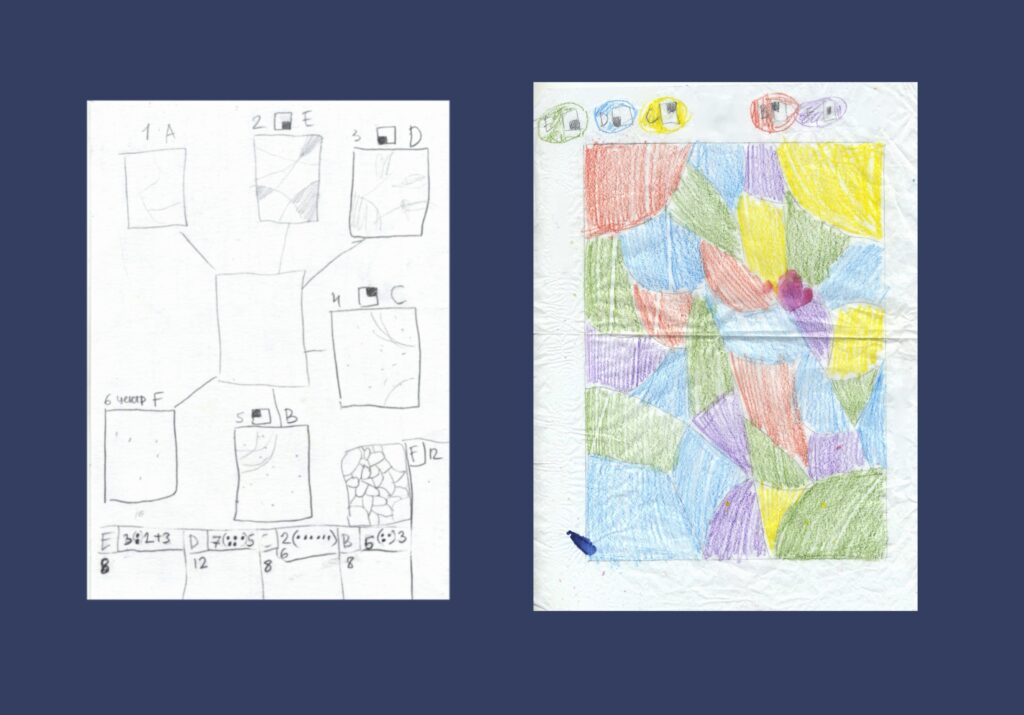
Eternal Harmony, Compositional principles
To achieve this, I deconstructed my traditional works and identified recurring structural patterns. This allowed me to divide compositions into layers and zones, enabling the coexistence of multiple visual ideas within a single canvas.
Eventually, I developed a workflow for creating and transferring analog images into digital form:
1. First, I draw the elements within a dedicated coordinate system;
2. Then I scan each element in high resolution;
3. After that, I process their contours using a digital brush;
4. Finally, all elements are loaded into an algorithm that randomly generates a large number of unique compositions.
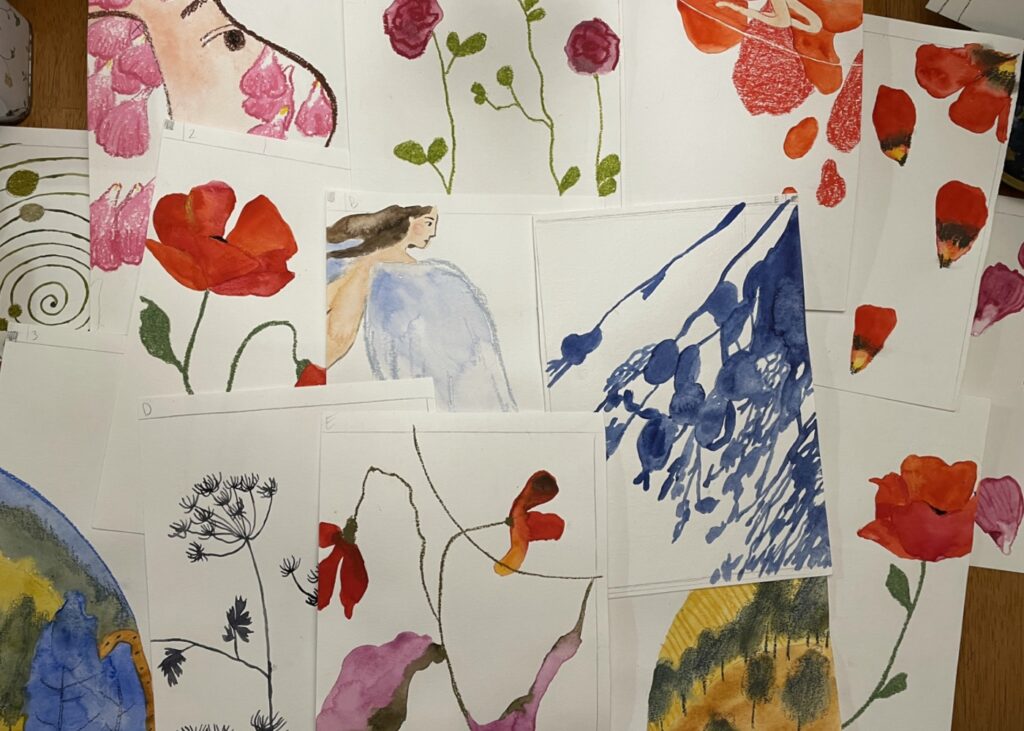
Eternal Harmony, Original elements
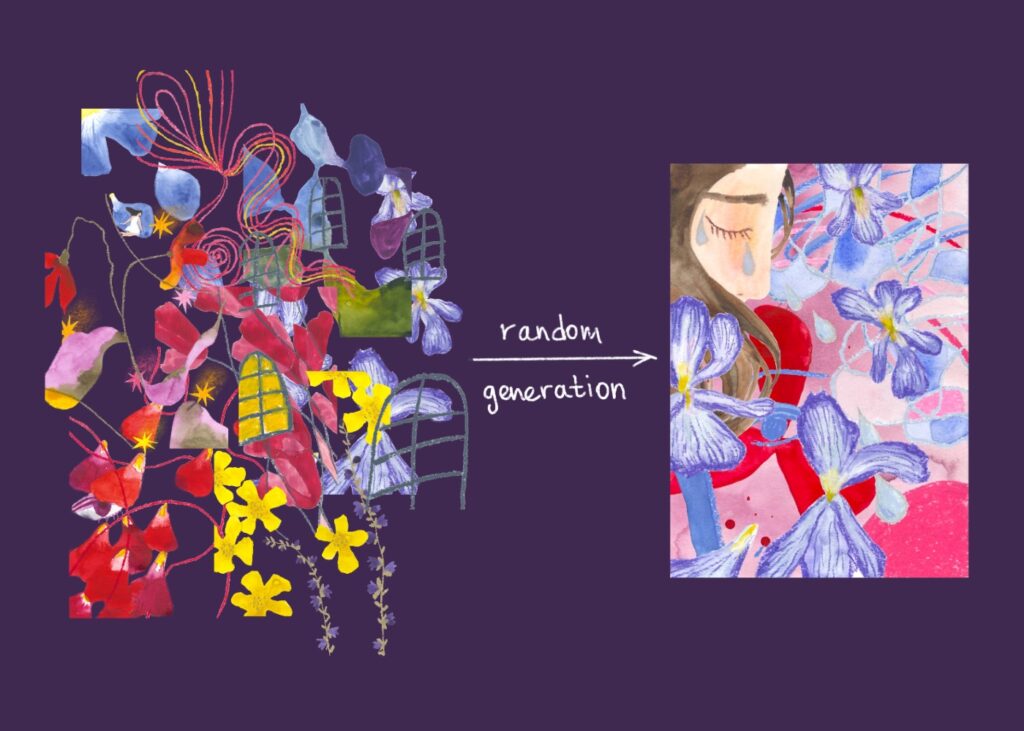
Eternal Harmony, Test generation
When I first saw the results, I was surprised by the sense of visual depth that emerged from the collage-like layering of elements. I was also drawn to the subtle edge illumination each form acquired. This effect emerged through digital contour processing.
These works are initially perceived as analog paintings, yet at some point the viewer realizes that they are digital. This shift creates a certain cognitive tension. The images appear as if reflected in water, merge into a unified mass, and protrude from different visual planes.
I believe this duality is the result of an algorithmic effect described by Jason Bailey, now manifesting not in purely digital generative art but in its fusion with traditional media. The complexity and emotional depth of analog form are multiplied by computational processes, giving rise to new aesthetic artifacts.
Still, this was not a complete solution for me. I also wanted to fully engage the temporal and autonomous properties of the blockchain itself. This led me to develop what I would describe as eternal paintings: works capable of transforming without my direct involvement, even long after my lifetime.
This project became Eternal Harmony.
One of the key inspirations was SALT V4 by Figure31 and 0xmons. The project consisted of 180 tokens whose images circulate between tokens daily, based on block.timestamp on Ethereum. Technically, this detail is both elegant and significant.
I adopted the same underlying principle but shifted the focus toward continuous image regeneration.
Each of the 250 tokens in Eternal Harmony represents a painting that exists for only three days. After that, it is permanently erased and replaced by a newly generated one. While every result is unique, all images share a common visual language, as they are created from the same pool of elements.
Why three days? I felt that daily changes would be exhausting. There would not be enough time to truly live with an image. Instead, I wanted the experience to feel like an unusual encounter that will inevitably end, giving you three days to fully experience it.
Technically, this is real-time generative art on the blockchain:
1. The generation process occurs on the Ethereum blockchain, while visual elements are stored on the decentralized Arweave network;
2. When a token is opened, a script retrieves the elements from Arweave and renders the image in real time on an HTML canvas;
3. Each painting is generated based on block.timestamp and token ID, and neither past nor future states are stored. Even I do not know what the next generation will look like.
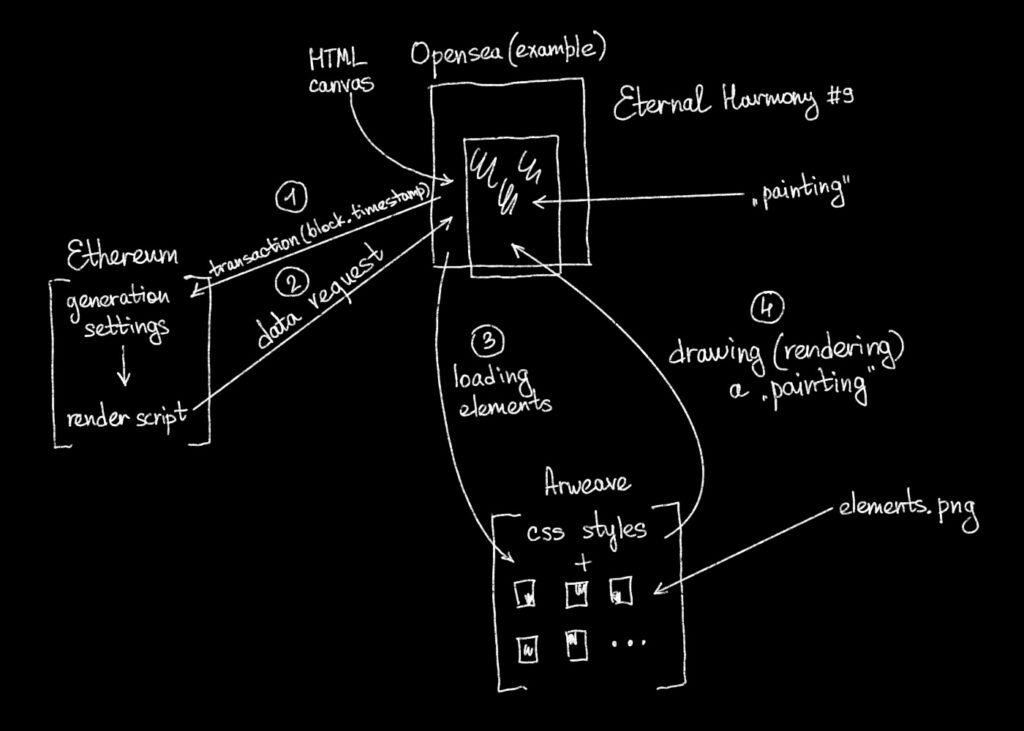
Eternal Harmony, Technology
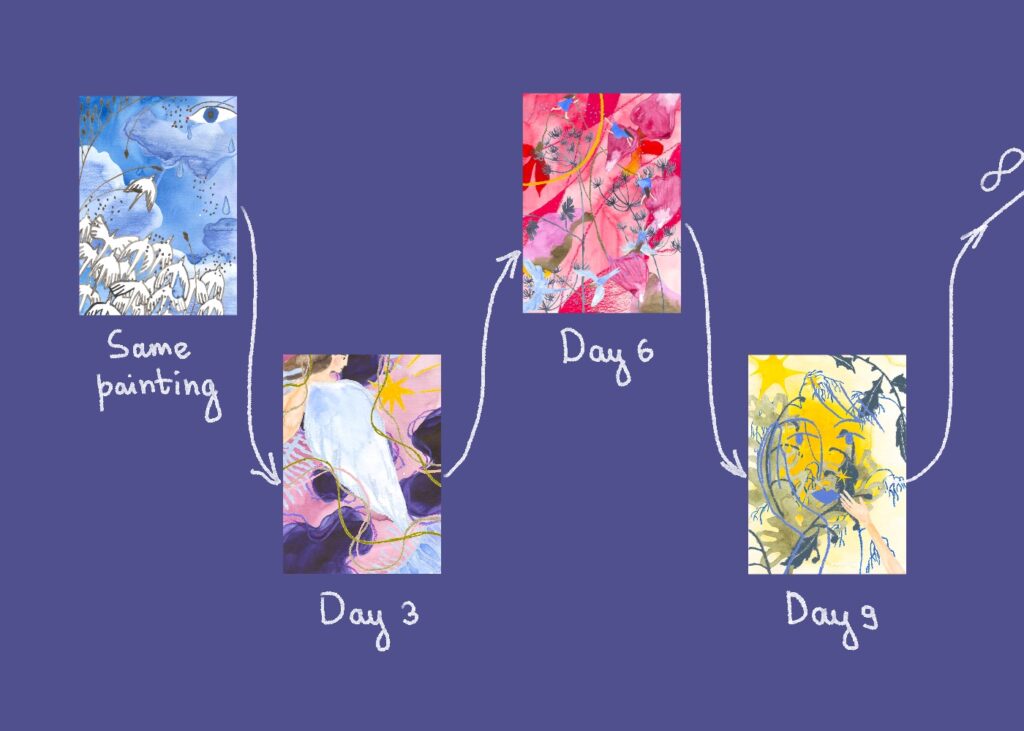
Eternal Harmony, Ever-changing process
Through this work, I addressed several questions that had occupied me for years. They can be divided into two groups: form and meaning.
(1) Form
I found a way to combine analog complexity—in composition, texture, color, and direct human involvement—with the scalability of digital systems.
I also managed to preserve the connection between the artist’s psyche and body within generative art, allowing me to shape form and imagery with the same physical sensitivity present in my traditional practice.
(2) Meaning
These formal discoveries enabled me to explore how images influence the viewer’s psyche. I have long observed that visual content can have both restorative and destructive effects, but Eternal Harmony allowed me to engage with this question more consciously than ever before.
In this project, I aimed to create works that could gently restore and inspire. I carefully observed what I drew, selecting softer, more harmonious forms, while preserving analog textures and color relationships.
This made the images feel more natural and, I hope, more comforting to perceive. Combined with generative algorithms, this approach allowed me to create enough variations for each viewer to encounter a truly personal and unique visual experience.
Looking ahead, I believe this direction will be explored more deeply in the future, potentially leading to artworks that adapt to the viewer’s inner state. Generative systems will likely play a key role in this evolution.
With gratitude to Figure31 and 0xmons (SALT V4), Harm van den Dorpel (Mutant Garden Seeder), Cory Haber (365 SOL), Marcel Schwittlick (Upward Spiral), Alpha Centauri Kid, yungwknd (Ethereal Rose), and Snowfro (Art Blocks).
Special thanks to Jason Bailey (Artnome) and Sam Spike for their thoughtful analysis of experimental blockchain art projects, which greatly influenced my research.
